2028 Chevrolet Traverse Redesign, Price, Release Date
2028 Chevrolet Traverse Redesign, Price, Release Date – The 2028 Chevrolet Traverse could become one of the most important family-oriented SUVs in Chevrolet’s lineup as the three-row midsize segment continues to become more competitive. The current-generation Traverse has already moved significantly beyond the formula of a basic family hauler, combining substantial passenger space with a turbocharged engine, available all-wheel drive, off-road-oriented Z71 hardware, sporty RS styling, and upscale High Country equipment. Chevrolet’s current 2027 Traverse offers seating for up to eight, a maximum 98 cubic feet of cargo volume, a standard 17.7-inch infotainment screen, and available Super Cruise hands-free driving technology.
For 2028, a completely different vehicle may not be necessary because the latest Traverse generation is already relatively new. A more realistic expectation is a carefully developed update focused on efficiency, software, interior refinement, suspension tuning, and additional convenience technology. Chevrolet has already established a strong foundation with a 2.5-liter turbocharged engine, eight-speed automatic transmission, available advanced twin-clutch all-wheel drive, and a towing capacity of up to 5,000 pounds. The next phase could concentrate on making those capabilities easier and more enjoyable to use every day.
The Traverse also occupies an interesting position within Chevrolet’s SUV portfolio. It is larger and more family-focused than the five-passenger Equinox and Blazer, yet it remains easier to maneuver and more efficient than the truck-based Tahoe and Suburban. That middle ground gives the Traverse a broad customer base. Families need usable third-row seating, but many do not need the enormous dimensions or fuel consumption of a full-size SUV. A future Traverse could strengthen that balance with more premium equipment and potentially electrified powertrain technology.
It is important to separate confirmed information from projections. Chevrolet has not announced a complete 2028 Traverse specification sheet, official redesign, final trim pricing, or confirmed release date. The 2027 model is therefore the strongest reference point for understanding what could carry forward. The following expectations represent a forward-looking assessment rather than confirmed Chevrolet specifications, especially regarding a possible hybrid powertrain, future styling changes, pricing, and launch timing. 2028 Chevrolet Traverse Redesign
2028 Chevrolet Traverse Redesign and Update Plan
Exterior & Interior
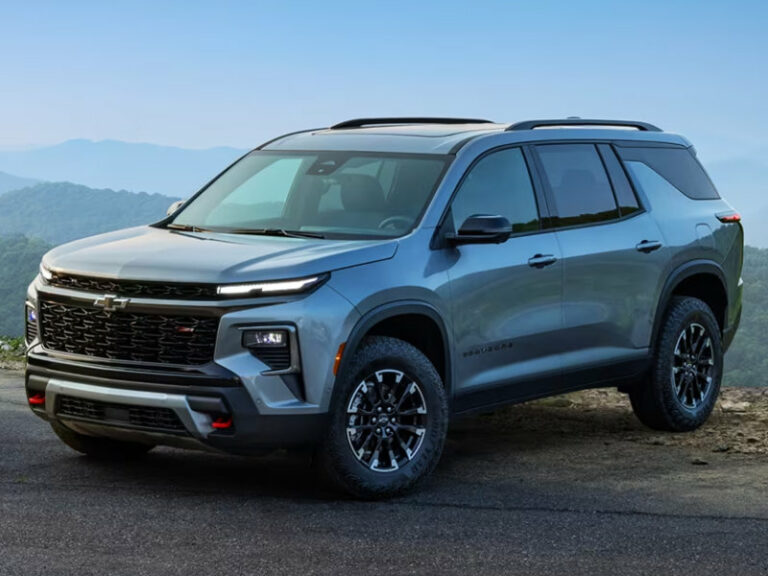
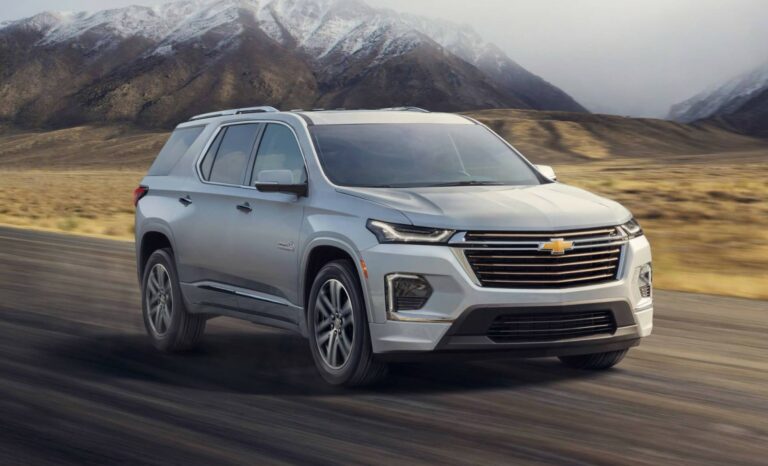
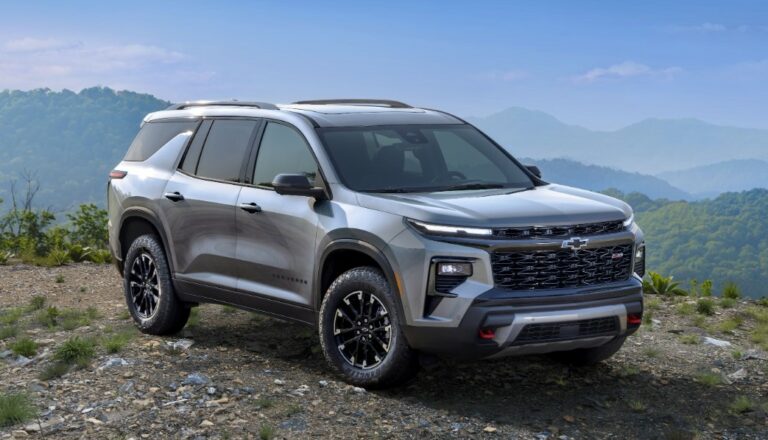
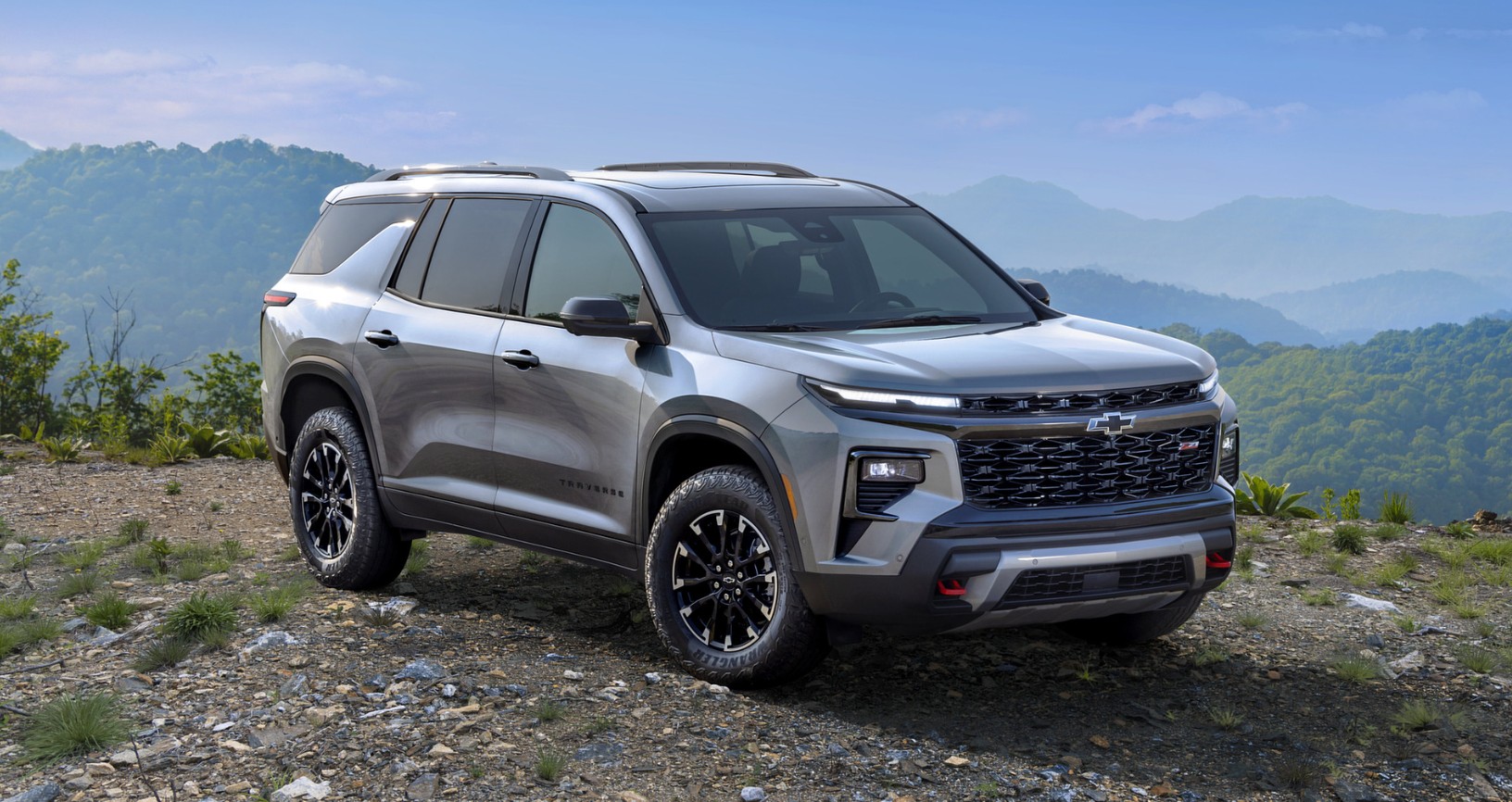
The exterior of the 2028 Chevrolet Traverse should continue using the bold proportions introduced with the latest generation. The current model measures approximately 204.4 inches long and 87.8 inches wide, giving it a substantial road presence without moving completely into full-size SUV territory. A future update could introduce a revised grille, slimmer LED lighting, new wheel designs, updated bumper details, and additional aerodynamic refinements. The basic silhouette is likely to remain because the upright body is closely connected to the Traverse’s excellent interior packaging.
Different versions should continue to have distinct visual identities. The LT would likely maintain a clean, family-oriented appearance, while the Z71 could receive darker trim, all-terrain tires, protective lower-body elements, and additional underbody protection. The RS would remain the street-focused alternative with blacked-out exterior elements, larger wheels, and sportier detailing. The current 2027 RS uses 22-inch black-painted aluminum wheels, black grille and roof-rail elements, RS badging, and red interior accents. A future model could expand the RS appearance package without compromising ride comfort.
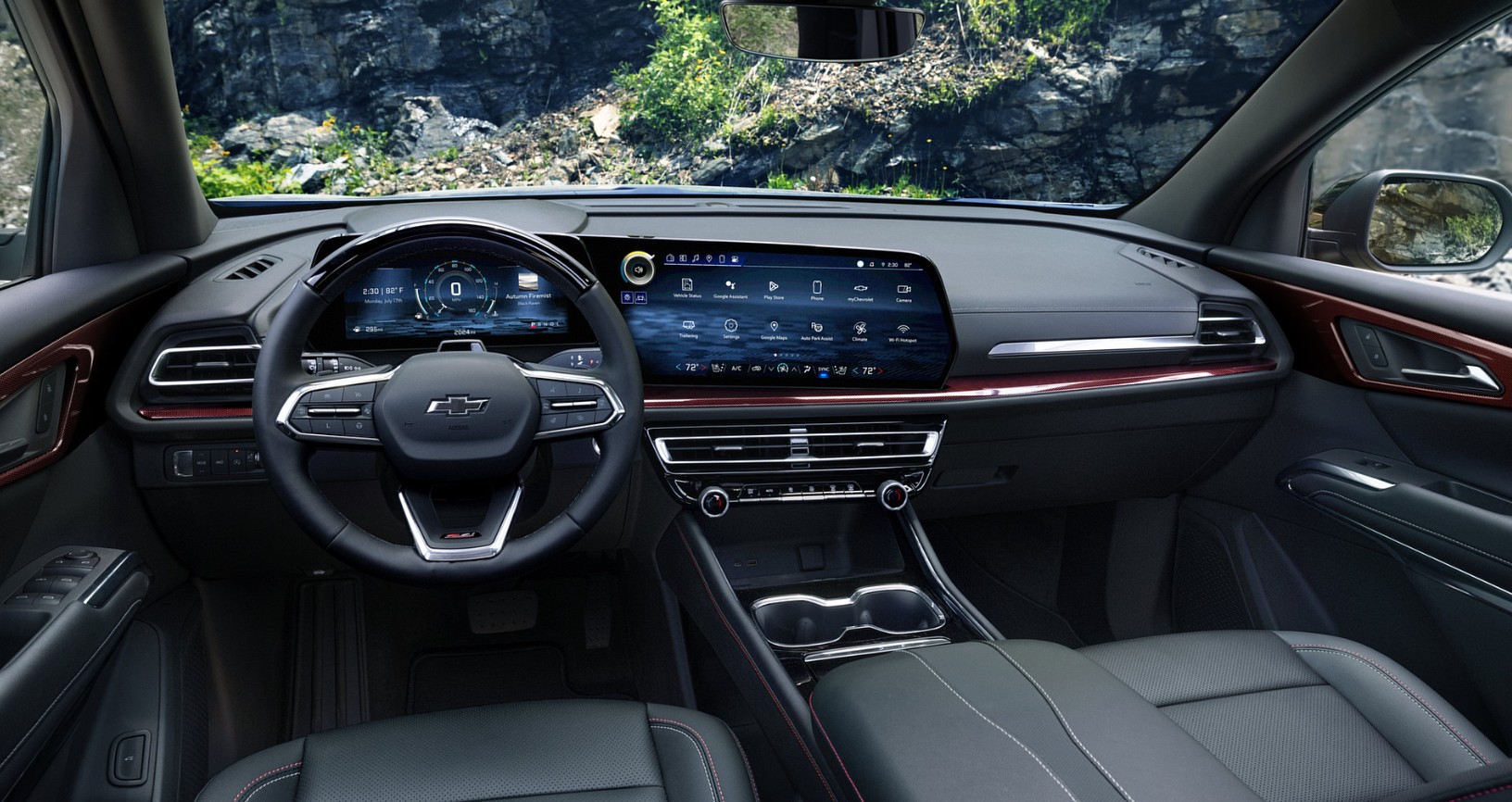
The cabin should remain one of the Traverse’s strongest advantages. Chevrolet currently offers seven-passenger seating on most configurations, while the LT can accommodate eight with an available second-row bench seat. The 2028 model could improve second- and third-row comfort with redesigned cushions, additional USB-C ports, better climate distribution, and more convenient storage. Families will likely appreciate small usability improvements just as much as dramatic styling changes, particularly easier access to the third row and more intelligently placed cupholders, charging ports, and storage compartments.
Cargo capacity is another area Chevrolet should preserve. The current Traverse provides 22.9 cubic feet behind the third row, 56.6 cubic feet behind the second row, and up to 98 cubic feet with the rear seating folded. Those numbers give it a major practical advantage over many midsize three-row crossovers. The next model could improve cargo organization with a more versatile underfloor storage area, additional tie-down points, powered seat folding, and a smarter power liftgate. Higher trims could also offer premium upholstery, real wood accents, ventilated seats, ambient lighting, and improved acoustic insulation.
The 2028 Chevrolet Traverse is likely to receive an evolutionary update rather than a completely new platform. The current generation already introduced a substantial redesign, including a much more upright exterior, a significantly larger cabin, a 17.7-inch infotainment display, improved cargo packaging, and a new 2.5-liter turbocharged engine. Another ground-up transformation only a few years after that redesign would be difficult to justify economically. Instead, Chevrolet could focus on improving the areas customers interact with most frequently, including infotainment response, suspension calibration, cabin noise, seating comfort, and energy efficiency.
One potentially significant development would be electrification. Chevrolet has been expanding its electrified vehicle portfolio, and a hybrid Traverse would make considerable sense for a family SUV that spends much of its life in urban traffic and highway commuting. A future hybrid could combine a turbocharged gasoline engine with electric assistance to improve low-speed torque and reduce fuel consumption. Such a system could also make the Traverse smoother during stop-and-go driving. Chevrolet has not confirmed a 2028 Traverse hybrid, however, so it should be regarded as a possibility rather than an expected factory specification.
The chassis could also receive targeted improvements. The current Z71 uses an advanced twin-clutch AWD system, Terrain Mode, Hill Descent Control, off-road suspension tuning, skid-plate protection, and all-terrain tires. For 2028, Chevrolet could refine the electronically controlled suspension and traction systems to make the Traverse more comfortable on pavement without weakening its capability on loose surfaces. The standard models could receive quieter suspension bushings and improved damping, while Z71 could gain additional drive modes or more sophisticated terrain management.
Technology will probably be another major focus. The current Traverse already features a large 17.7-inch screen and an 11-inch driver information display, while Google built-in compatibility and Google Gemini are available. A future model could add faster processing, improved voice interaction, more intelligent navigation, expanded over-the-air updates, and enhanced energy-management features if a hybrid or electrified version arrives. Trailer information could also become more deeply integrated into the digital interface, allowing drivers to monitor hitch status, trailer lighting, tire pressures, and estimated range while towing. 2028 Chevrolet Traverse Redesign
2028 Chevrolet Traverse Specs
Engine & Performance
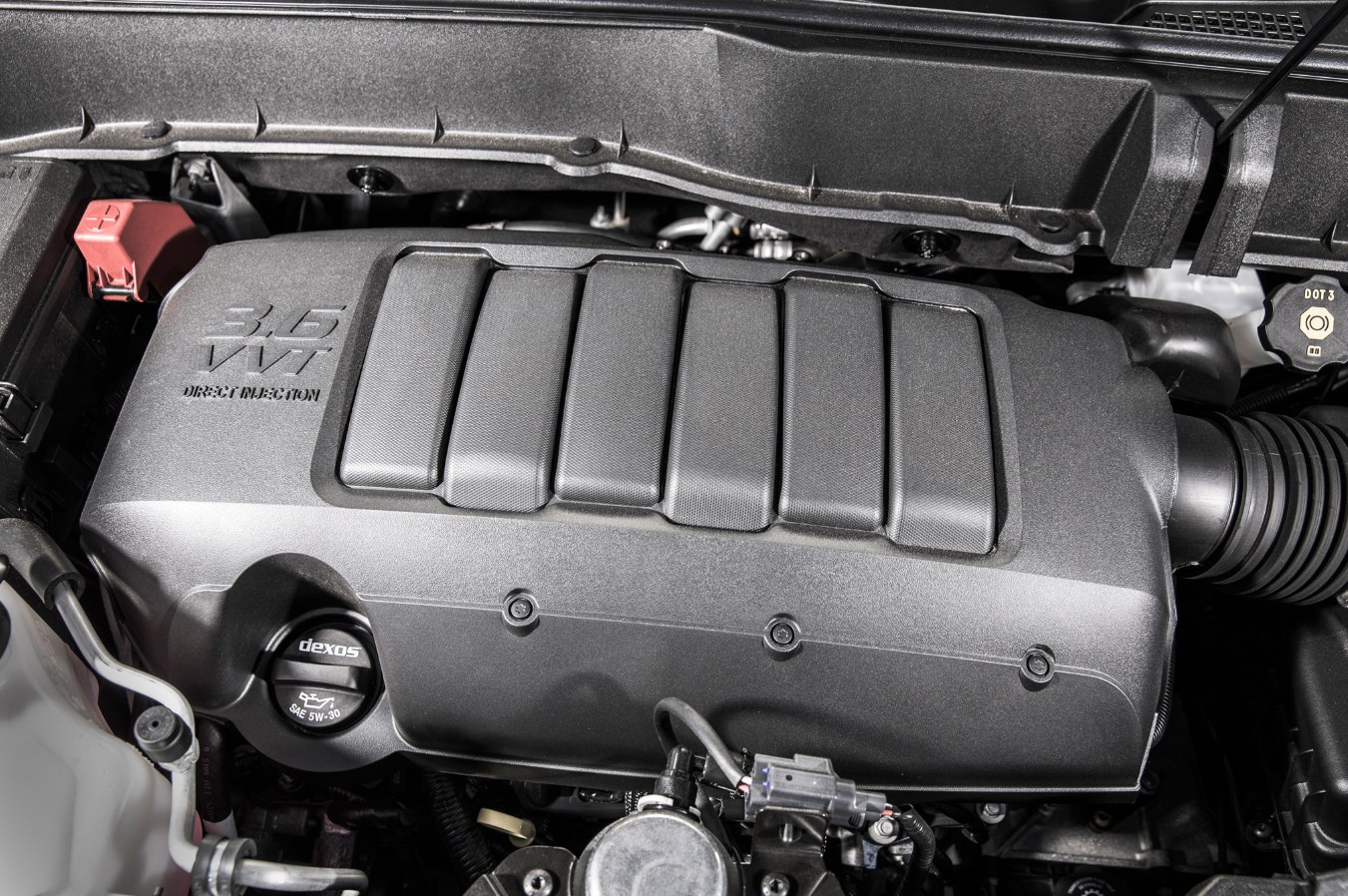
The 2028 Chevrolet Traverse is expected to continue using the 2.5-liter turbocharged four-cylinder as its primary internal-combustion powertrain if Chevrolet maintains the current mechanical formula. The 2027 Traverse produces 328 horsepower and 326 lb-ft of torque, paired with an eight-speed automatic transmission. That is a substantial amount of output for a midsize family SUV, allowing the Traverse to provide stronger acceleration and towing capability without relying on a naturally aspirated V6.
The current engine also provides a useful balance between performance and efficiency. Chevrolet rates the 2027 front-wheel-drive Traverse at 20 mpg city and 26 mpg highway. A 2028 update could focus on reducing friction, improving thermal management, optimizing transmission shift behavior, and refining engine calibration. If Chevrolet can improve highway efficiency without sacrificing the 328-horsepower output, the Traverse would become even more attractive for families who frequently travel long distances.
All-wheel drive should remain available, with the Z71 continuing to represent the most capable configuration for rougher terrain. The advanced twin-clutch AWD system in the current Z71 can actively manage torque between the rear wheels, while Terrain Mode and Hill Descent Control provide additional assistance on loose or steep surfaces. For 2028, Chevrolet could make AWD software even more predictive, using vehicle sensors to anticipate changes in traction rather than waiting for wheel slip to occur.
2028 Chevrolet Traverse Fuel Economy
A hybrid powertrain could provide the most interesting change. A turbocharged hybrid Traverse might target roughly 300 to 350 horsepower while offering considerably better urban fuel economy than the current gasoline-only configuration. Electric torque could also make the SUV feel stronger during initial acceleration, particularly when carrying passengers. A plug-in hybrid is another theoretical possibility, but there is currently no confirmed evidence that Chevrolet plans one for the Traverse. Until official EPA figures are released, projected efficiency should not be treated as a final specification.
Towing is another area where the Traverse already performs strongly. Chevrolet rates the current model for up to 5,000 pounds of towing capacity, with LT, Z71, and RS configurations equipped with trailering equipment. The current vehicle also includes trailering technology such as Hitch View, Hitch Guidance, and the Trailering App. A 2028 update could make these tools even more sophisticated, particularly if the vehicle receives expanded camera coverage and predictive trailer-range calculations.
2028 Chevrolet Traverse Safety Features
Safety should remain one of the strongest reasons to choose the 2028 Chevrolet Traverse. Chevrolet already equips the current model with more than 20 standard safety and driver-assistance features. Available systems include Super Cruise, while the standard safety suite includes technologies such as Front Pedestrian and Bicycle Braking, Blind Zone Steering Assist, Rear Cross Traffic Braking, Automatic Emergency Braking, and Safety Alert Seat. A future model could expand this package with more advanced sensors and improved software capable of detecting potential hazards earlier.
Super Cruise could become even more widely integrated into the Traverse range. The 2027 RS and High Country include Super Cruise as standard equipment, making hands-free highway driving a major part of the model’s premium positioning. For the 2028 model, Chevrolet could expand the system’s capabilities with improved automatic lane changes, better navigation integration, construction-zone recognition, and more advanced driver monitoring. Such features would be particularly valuable for families using the Traverse for long interstate journeys. 2028 Chevrolet Traverse Redesign
2028 Chevrolet Traverse Release Date & Price
The release date is not officially confirmed. Because the current Traverse generation was substantially redesigned recently, Chevrolet could continue selling an updated version into 2028 without introducing an entirely new generation. A 2028 model could therefore be revealed during the 2027 calendar year, with production beginning later in 2027 or during early 2028. Alternatively, Chevrolet could retain the current specifications with only minor annual changes. Any specific release month should be treated cautiously until Chevrolet publishes an official launch schedule.
The trim lineup should remain familiar because Chevrolet has already created a useful range of personalities. The LT serves as the practical mainstream version, while Z71 is aimed at buyers who want off-road capability. RS focuses on sportier styling and premium technology, and High Country occupies the luxury-oriented top position. Chevrolet currently lists the 2027 Traverse starting around $40,800 for LT, $49,100 for Z71, $55,800 for RS, and $56,100 for High Country, although displayed pricing can vary by market and configuration.
For 2028, a moderate price increase would be reasonable. A projected starting MSRP around $42,000 to $43,000 would position the LT competitively against other three-row midsize SUVs. Z71 could move toward $51,000, while RS could approach $58,000. High Country could reach approximately $59,000 to $62,000 depending on equipment. If Chevrolet introduces a hybrid powertrain, it would likely carry a premium of several thousand dollars, particularly if it includes a larger battery and more sophisticated electronic hardware. These figures are projections rather than confirmed Chevrolet pricing.
Conclusion
The 2028 Chevrolet Traverse has a strong foundation because the current generation already addresses many of the weaknesses that once limited three-row midsize SUVs. It offers substantial passenger space, up to 98 cubic feet of cargo capacity, a 328-horsepower turbocharged engine, available all-wheel drive, 5,000 pounds of towing capacity, and modern technology centered around a 17.7-inch display. Those characteristics give Chevrolet plenty of room to refine the formula rather than starting over.
The biggest opportunity could be electrification. A hybrid Traverse would improve the SUV’s appeal to buyers who want three rows and useful towing ability without accepting the fuel consumption associated with larger truck-based SUVs. Even without a hybrid, improved engine calibration, transmission programming, aerodynamics, and thermal management could produce measurable efficiency gains.
The Z71 and RS versions also give the Traverse a broader personality range than many competitors. Z71 can appeal to outdoor-oriented families who want more capability away from paved roads, while RS offers a sportier visual identity for buyers who spend most of their time in urban environments. High Country then provides a premium alternative for customers who want upscale materials and advanced technology without moving into a Tahoe or Suburban.
For now, the 2028 Chevrolet Traverse remains a future model without confirmed final specifications, pricing, or release timing. The current 2027 Traverse provides the clearest indication of Chevrolet’s direction, and that direction is encouraging: more space, stronger technology, useful performance, available off-road capability, and increasingly sophisticated driver assistance. If Chevrolet adds meaningful efficiency improvements and continues refining the cabin, the next Traverse could become an even stronger choice for families who need genuine three-row practicality without the size and operating costs of a full-size SUV.